Shifty - This is a film embodies the new Crime genre in Britain on a low budget film brilliantly as it is not attempting to be something it isn't. This film shows the transition of British Crime, particularly in the early 2000s as this is when this culture started to become more mainstream as seen with any culture once it starts to be mirrored in film.
Lock Stock and Two Smoking Barrels - A Guy Ritchie directed film shows the Geezer archetypal characters which the British are more well known for. This film focuses on the cockney culture which is often portrayed in film, this was one of the first of this type to become a cult classic. This is the stage before Shifty demonstrating the another side to British urban crime which may be slowly dying out and losing relevance as the new culture among the youth in Britain is only recently becoming majorly popular in music and clothing, meaning possibly soon in film too.
Trance - This is a Danny Boyle directed film meaning it will have elements of British realism however this is very different from other British Crime as it takes on an almost spiritual storyline mixed with violence and a hazy mood. This is the opposite to Shift and Lock Stock where grittiness and the urban mise en scene is vital, most of Trance takes place in a home. This demonstrates the more experimental side of British Crime suggesting audiences do enjoy a complete change in style to common urban crime no matter which form of British culture it comes from.
These 3 films are the ones I will be focusing on during my research into the Transition of British Crime as I believe they show a variety of types of film, each different and with their own cultural influences.
Friday, 18 September 2015

Thursday, 17 September 2015
Trance, a more sophiticated British Crime Film.
https://www.youtube.com/watch?v=cQ-qYX9Oz1c
'Though it rings ever so slightly hollow as cool shades into callousness, this exercise in sexy suspense and brain-scrambling mystery is a dazzling, absorbing entertainment which shows off Danny Boyle’s mastery of complex storytelling and black, black humour.'
This is a review from Empire magazine and the trailer will show how different this film is to the others I have been focusing on as its main focus is neither 'Geezers' or new wave urban crime. This has its own style although involving thugs it is not the films main theme as with many British urban films, our main character for once is a true protagonist rarely seen in British film, particularly Urban Crime. For example in Kidulthood our protagonist tortures someone, in Snatch Mikey (although out of revenge) kills the cockney gangsters. This is often because of the British tendency to lean towards realism however Trance differs as it brings a certain amount of pseudoscience to the film. However it still carries a certain amount of the British Crime genre in it allowing for an interesting and entertaining viewing experience. I believe its target market must have been wider than films such as Bullet Boy for example.
'Though it rings ever so slightly hollow as cool shades into callousness, this exercise in sexy suspense and brain-scrambling mystery is a dazzling, absorbing entertainment which shows off Danny Boyle’s mastery of complex storytelling and black, black humour.'
This is a review from Empire magazine and the trailer will show how different this film is to the others I have been focusing on as its main focus is neither 'Geezers' or new wave urban crime. This has its own style although involving thugs it is not the films main theme as with many British urban films, our main character for once is a true protagonist rarely seen in British film, particularly Urban Crime. For example in Kidulthood our protagonist tortures someone, in Snatch Mikey (although out of revenge) kills the cockney gangsters. This is often because of the British tendency to lean towards realism however Trance differs as it brings a certain amount of pseudoscience to the film. However it still carries a certain amount of the British Crime genre in it allowing for an interesting and entertaining viewing experience. I believe its target market must have been wider than films such as Bullet Boy for example.
Guy Ritchie and new British Crime
He is responsible for Lock Stock and Snatch, both great films however he has directed some more disappointing productions such as RocknRolla (depending on taste). However he has also moved away from Geezer films to Sherlock Holmes which I believe lacked substance and relied on style more than a plot. This issue is rare in the new wave of British crime as they are often made on small budgets such as Shifty which doesn't allow for the expensive GCI styles used in Sherlock. This does not mean the new wave of British crime films are all great, far from it, many of the productions have a fairly predictable story line such as Bullet Boy. Films such as Shifty and Kidulthood have kept the genre alive however generally on a smaller scale than their Cockney cousins.
Anit-Social
https://www.youtube.com/watch?v=WocnaoX-HNU
This trailer is of a new Film called Anti-Social starring MC's Skepta and Devlin. This film is due to be released this year reinforcing my point of the new culture which seems to have dominated the British crime genre in recent years. This shows how much music can effect a culture and even create a new sub-genre of film.
This trailer is of a new Film called Anti-Social starring MC's Skepta and Devlin. This film is due to be released this year reinforcing my point of the new culture which seems to have dominated the British crime genre in recent years. This shows how much music can effect a culture and even create a new sub-genre of film.
Tuesday, 15 September 2015
British Gangster Representation in Shifty
The 'hoodie' sub-genre of British gangster films is portrayed excellently in the film 'Shifty' which I have recently watched. These films only recently started to replace the Geezer archetype in the last 15 to 20 years. The 'hoodie' representation of the British gangster may indeed be more relevant to young British audiences as the language, accent and clothing is more familiar to them in their everyday lives. Particularly the line in the film as he says 'this isn't college anymore' suggests anyone could become like Shifty (the protagonist). https://www.youtube.com/watch?v=DT75k8sUXaQ Here is the trailer.
Thursday, 10 September 2015
Layer Cake
https://www.youtube.com/watch?v=C41JsRUGgzU
This film (here is the trailer) shows the bleak, realistic style often used in British film including plenty of long shots and fewer cuts than an American production. The 'gentleman' figure portrayed by Daniel Craig demonstrates the change of the British Gangster culture and how the 'Geezer' stereotype may be becoming less relevant.
This film (here is the trailer) shows the bleak, realistic style often used in British film including plenty of long shots and fewer cuts than an American production. The 'gentleman' figure portrayed by Daniel Craig demonstrates the change of the British Gangster culture and how the 'Geezer' stereotype may be becoming less relevant.
Kidulthood and its impact
This film incorporated the social aspect of British culture and its drama among young people as well as being orientated around the theme of the Gangster. I believe this lead the way to British drama soaps such as Skins, although this does not contain anything to do with gangsters the social circle and its importance is shown in both Kidulthood and Skins.
Although the two star review given by Empire to Kidulthood is negative it does show the way for a new type of British Gangster which is more relatable for the new generation.
Although the two star review given by Empire to Kidulthood is negative it does show the way for a new type of British Gangster which is more relatable for the new generation.
Wednesday, 9 September 2015
Harry Brown
Harry Brown is interesting as the protagonist and antagonist have a role switch near the end of the film bringing up questions about morality as well as leaving the viewer with a sense of ambiguity and yet pleasure. The protagonist mimics the drug dealer/low-life gangsters violent actions with his own, this also shows the more unpredictable ending to British cinema which can be seen in films meant to include the theme of realism which many do. https://www.youtube.com/watch?v=l9rmHPmnnKw
Book on Social Realism
'British Social Realism' by Samantha Lay speaks of the film 'The Full Monty' explaining the loss of masculinity or the 'masculinity crisis' she says was appearing in films at that time depicting them being weak, turning to violence, and drug abuse. I believe this could have helped lead the way to British Gangster films as many turned to this lifestyle (or so portrayed so in the films like Lock Stock and Krays) as films in the early 1990's showed "weakening of the ideologies of masculinity"according to social realist John Snow. This would suggest that glorifying these types of characters and their behaviours would allow it to morph into something masculine again.
Relevant Article and comments on British Gangster Film.
This is an article I found on the BFI website.
(http://www.screenonline.org.uk/film/id/1347840/index.html)
This article demonstrates that the 'cockney' Gangster stereotype used in many of the films I have previously mentioned including 'Lock stock and two smoking barrels' and 'RocknRolla' both directed by Guy Ritchie are slowly becoming less relevant due to the new urban culture shown in 'Shank' and 'Kidulthood'. The TV series 'Top Boy' has however been cancelled for a third series on Channel 4 which disappoints me, this may be due to the low budget given to British cinema by our government.
The representation of the British Gangster is changing due to cultural influences, does this signify an end to the British Geezer Films.
(http://www.screenonline.org.uk/film/id/1347840/index.html)
This article demonstrates that the 'cockney' Gangster stereotype used in many of the films I have previously mentioned including 'Lock stock and two smoking barrels' and 'RocknRolla' both directed by Guy Ritchie are slowly becoming less relevant due to the new urban culture shown in 'Shank' and 'Kidulthood'. The TV series 'Top Boy' has however been cancelled for a third series on Channel 4 which disappoints me, this may be due to the low budget given to British cinema by our government.
The representation of the British Gangster is changing due to cultural influences, does this signify an end to the British Geezer Films.
Thursday, 27 August 2015
Darren, sales manager at a plastics firm in Milton Keynes, is a force to be reckoned with in the British film industry. In part, he’s the reason why British crime cinema – low-budget, morally dubious and about as disreputable as it’s ever been – is the genre that refuses to die. At least, Darren would if he actually existed. Darren, it turns out, is a theoretical construct; an audience archetype identified by Jezz Vernon, managing director of distribution outfit Metrodome, the people who released recent examples of the form such asThe Guvnors, St George’s Day and The Fall of the Essex Boys.
“We always talk about the buyer of a film,” says Vernon. “For someone like Darren, there’s a certain boredom about his existence, and the attraction to gangsters or football hooligans has a certain aspirational element to it. It might sound worrying, but we liken it to music: the mainstream in UK music has always liked poetic thugs, from Byron to Liam Gallagher. People like the paradox; both the masculinity of it, and the denial of it.”
These are the films about top boys and bent cops, where blaggers are tooled up and hard men mugged off. Poster artwork invariably spotlights major-league violence: either a massive ruck, or heavy weaponry, or both. Largely London-based – and more specifically, the eastern half of the capital, stretching out to the Essex suburbs, they are suffused with suppressed rage and a fierce commitment to clan honour. Vernon points out that the hooligan movie is, as a micro-genre, distinct from the gangster movie, but they are connected by “very tribal, geographically based consenting violence between two opposing groups”. Many films, however, force a connection between the two, with the likes of The Rise and Fall of a White Collar Hooligan making a direct link between football terrace shit-kickery and large scale organised crime. The auteurs of this world are people such as Nick Love andJulian Gilbey; it nourishes its own acting stable with the likes of Frank Harper,Alan Ford and Craig Fairbrass.
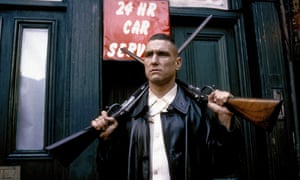
The existence of a solid, hardcore audience who keep watching means that, on some level, this is a self-perpetuating, self-funding sector; evidence in its rawest form that a British film industry does indeed exist. They don’t get anywhere near state-disbursed funding, and nor, you suspect, would they want to. In some cases, the figures are staggering: two of the original hooligan films, Green Streetand The Football Factory, sold well over a million DVDs each, while The Business, the 80s-set Costa del Crime saga that shot Danny Dyer to fame in 2005, shifted more than 800,000. Not every film can achieve that, and Vernon says that DVD sales have declined rapidly in the past year or two; but even a small-scale release, such as the Glasgow-set The Wee Man, can muster 100,000.
That makes the economics of the low-budget crime movie attractive even if, as Vernon is the first to admit, “they don’t export well”. The culturally specific argot, the narrowly British concern with football, and the genre’s fascination with certain key crimes – notably the notorious Rettendon murders in 1995 – mean that unlike other areas of the British film industry, little concession is made to what overseas audiences, particularly in the US, will make of it all.
Quite why the Rettendon murders, in which three drug dealers were found shot dead in a Range Rover in a small village near Chelmsford, exerts such a grip on film-makers’ imaginations is bit of a puzzle: by Vernon’s count, eight films have been made about it, including Essex Boys, Rise of the Footsoldier, Fall of the Essex Boys and Bonded by Blood. Other “clusters” in the genre include the recent tweak in which older-generation hoolies and hard men scrap with hoodie-wearing youngsters, a clash-of-subcultures hybrid amplified in The Guvnors andWe Still Kill the Old Way.
But what distinguishes these films from the cheap-and-cheerful thrillers of earlier, hokier eras is the sense that, somehow, they bear the imprint of the real thing. Authenticity is the watchword; the current flood of films was anticipated by, and to a large extent based on memoirs published by a media-literate generation of lawbreakers, anxious to secure what Vernon refers to their “legacy”. It is a central irony that the trigger for it all, the door-opener if you like, was the arrival in the late 90s and early 2000s of “mockney” films such as Lock Stock & Two Smoking Barrels and Love Honour and Obey, in which Primrose Hill types rubbed shoulders with proper hard-men such as Lenny McLean. Since then, the films have, in general, got more dour, nastier, and more self-justifying, if equally celebratory.

A key player in all this is Cass Pennant, a former member of West Ham’s infamous Inter City Firm, who turned his dramatic life story into, first, a memoir – called Cass – and then a film, also called Cass, released in 2008. Now 57, and still a physically imposing figure, Pennant is set up as a film producer, operating from a room above a pub just off Great Portland Street in London’s West End. Pennant’s credibility with what he calls “the in-crowd” (not, it’s safe to say, the bearded asymmetrical haircut types) means he is regularly called on as an on-set consultant, as well as to act as a negotiator between film-makers and the hard-men they want to involve in their movies.
Pennant says his film-making activities go all the way back to The Firm, Alan Clarke’s ground-breaking hooligan film starring Gary Oldman, for which he acted as an uncredited adviser. But his real reverence, and acknowledgement of a foot in the film-making door, is reserved for documentary-maker Ian Stuttard. Pennant says Stuttard agreed to spend a year gaining the gang’s trust before they allowed him to complete the now-seminal Hooligan in 1985. (“He got footage no one could ever dream of getting.”) Pennant got his first taste of film-making by demanding a seat in the editing room (“certain faces couldn’t be seen”). On the back of his book success – and eight subsequent titles, including Top Boys: True Stories of Football’s Hardest Men and 30 Years of Hurt: A History of England’s Hooligan Army – Pennant first set up a publishing imprint and then began trying to interest the film industry in his stories. He had a brush with Guy Ritchie (Pennant and his co-writer Neil Bowers sued Ritchie over contributions to the script for Snatch, and settled out of court), before getting Cass off the ground and a credit as co-producer.
He invested a lot of effort in The Guvnors, easing the way for a scene that featured a gathering of former streetfighters: to the uninitiated, it looks like a group of ordinary middle-aged men watching a football game, but in fact they are veteran top boys from Hartlepool, Nottingham, Birmingham, and of course, West Ham. Twenty years ago there would be no chance of them being in the same room without chairs flying, but these days passions are somewhat spent. Even so, Pennant still has to phone ahead to warn “a city” he is coming up for a meeting.
Pennant, and presumably his in-crowd compadres, sees the films as a way of preserving the values and reinforcing the mythology of a certain era – “respect” is a word that still gets bandied around a lot – but, interestingly, for him race is not a foreground issue. He is much more concerned with the class barriers that, in his view, corral the film industry for the well off. “Film is purely owned by the middle classes. Only the middle classes can make the films, but they can’t have those lives. They belong to the working classes. The stories belong to the East End. It’s like a marriage.”


The 50 or so titles that Pennant issued as a publisher – a considerable chunk of which are other hardman testimonies – now act as leverage for Pennant’s move into production. His company, called Urban Edge (Stuttard is his partner) released its first effort in 2011. Not unsurprisingly, it was a youth-culture documentary called Casuals, which played to Pennant’s two main strengths: 80s street fashion and football violence. He does, however, have bigger ideas: emphasising that Cass was as much about “identity” as violence, he is planning a film about the 2Tone movement, through the story of a mixed-race girl who, oddly enough, ended up running with a terrace gang.
Could this be an indication that the British crime thriller is running out of legs – or, at least, is looking to adapt to survive? Other recent examples – such as the Andrew Hulme-directed Snow in Paradise – have tried to recalibrate it, by introducing more spiritual elements and calling attention to the genre’s not-entirely-invisible racism. This week, another low-budget number, Hackney’s Finest, aims to do a Tarantino on the British drugs thriller – again, based on real life material. (The writer, Thorin Seex, was discovered by director Chris Bouchard in his mum’s writing group.) In some ways, Hackney’s Finest is the absolute opposite to the likes of Cass; Bouchard’s background as a VFX artist at the Framestore effects house means the film has a surface flash few others could manage, and the film has a bloodsoaked, black-comic tone that is fundamentally unserious. (Plus Bouchard is an unlikely figure to be trying this sort of hyperviolent, gun-infested malarkey: a soft-spoken type, he’s best known for the Tolkien fan film The Hunt for Gollum, which went viral in 2009.)
But there is a connection there: the hard-men thrillers that Pennant promotes, and Vernon sells, are fan films themselves, in a way. The intimate relationships between the subjects and participants, mean they operate as both description and fantasy: they both simultaneously criticise and glamorise – which you suspect, deep down, is the way Darren likes it.
Hackney’s Finest is on release from today.
'Cockneys vs Zombie's' shows the Geeza culture in British film is still relevant, this again demonstrates how the genre of British Gangster film can be merge with the comedy genre. However this film also brings the Horror genre, more specifically the realism aspect of British Horror to the audience. (keeping in mind the Comedy aspect of the film is stronger than the realism sub-genre of horror).
A strain of comedy has emerged from the British Gangster genre including 'Ali G' and 'Anuvaood'. This exchange from a gritty, urban style to a humours, lighted hearted approach means 'Anuvahood' most likely carried audiences from the drama/thriller film 'Kidulthood' creating awareness for this new culture in the UK.
British Film
The other is the West Caribbean culture
which in the past 20 years has become ingrained in our culture and therefore to an extent, our films.
Monday, 22 June 2015
GEEZERS
I enjoy British gangster films like Snatch and Lock Stock and Two Smoking Barrels because they represent a part of our culture which is not found in American Cinema. The tongue-in-cheek humour used throughout both of these films reflects my own humour to an extent and this is another reason I find them enjoyable. I am also interested at why these films recently have be failing compared with their success in the late 90's. I believe this could be due to the influence of a new culture among the youth which seems to abolish the east end Geezer archetype with West Indian mixing with British culture.
Subscribe to:
Posts (Atom)